Turning a One-Size-Fits-All Experience into a Personalized Player Home
Timeline
May 18-22 (Onsite week)
Disciplines
Product Strategy
UX Design
Personalization
Prototyping
Team
Product
Design
Engineering
Content
What
A personalized EA.com home experience that adapts to each player’s lifecycle, interests, and
in-game behavior.
Why
EA.com treated every player the same, missing opportunities to make the experience more relevant, re-engage players, and support conversion.
Who
New, active, and lapsed EA players with different needs, behaviors, and levels of engagement.
Overview
Developed during an internal EA hackathon with a cross-functional team across product, design, engineering, and content. We explored how EA.com could use player data to create more relevant experiences across the player lifecycle.
I left EA shortly afterward, before implementation and experimentation began.


The Problem
EA.com treats every player the same, regardless of whether they’re
new, active, or lapsed. There’s limited incentive to sign in, onboarding
support is minimal, and high-intent moments to re-engage or convert
players are missed. As a result, we leave engagement, login value, and
revenue opportunity on the table.

Different Players, Same Experience
Even after logging in, site like the FC26 homepage is essentially one-size-fits-all—showing the same content whether you don’t yet own the game or you’ve played 100+ hours.

Player who doesn't own FC 26
Player who has logged 100+ hours on FC 26


The Opportunity
Use lifecycle and behavioral signals to give each player a more relevant reason to play, progress, or return.

Solution
We’re building a personalized franchise player page (“My Space”) that dynamicallyadapts to a player’s identity, lifecycle stage, and in-game behavior.
It earns trust over time by consistently meeting players where they are. The goal is to become a reliable conduit back into play by surfacing the righ
Personalization Strategy
The Right Next Thing at the Right Moment
We explored how player data could make EA.com more relevant to each player — adapting what they see based on how they play, where they are in their journey,
and what they might need next.
The Highly Engaged player
Plays frequently and cares about improving performance. → Surface progress, performance insights and goals.
Current FC26 homepage - Authenticated
Updated homepage -
Authenticated
☆ gEDEMah plays FC regularly and is focused on improving his competitive performance, so generic FC content has limited value.
My Space uses his player data to surface performance, weekly goals and relevant Ultimate Team content—giving him a reason to return between sessions while creating more natural opportunities to discover offers tied to his goals.


The Casual Player
Plays less consistently and needs clear, relevant ways to jump back in.
Current FC26 homepage - Authenticated
Updated homepage -
Authenticated
☆ ShotofSweat plays FC more casually, so when she returns, she needs a quick way to understand what’s worth jumping back into.
My Space uses her recent activity and progress to surface clear next steps, relevant challenges and social prompts—reducing the effort of getting back into FC and giving her a more relevant reason to return and keep playing.

☆ LilZachy plays The Sims 4 around challenges and goals, so generic promotions aren’t always relevant to what he’s trying to do.
My Space uses his current challenge and progress to surface related content and recommend a pack that could help him complete it—making the offer feel connected to what he’s already trying to achieve rather than a separate promotion.
The Challenge-Driven player
A casual player who plays less consistently and needs clear, relevant ways to jump back in.
Current Sims 4 homepage - Authenticated
Updated homepage -
Authenticated


Personalization at scale
One System, Different Priorities
My Space wasn’t designed as a separate experience for every type of player. Instead, the same flexible system could prioritize different content based on signals about where a player was in their journey and how they played.

Technical Feasibility for V1
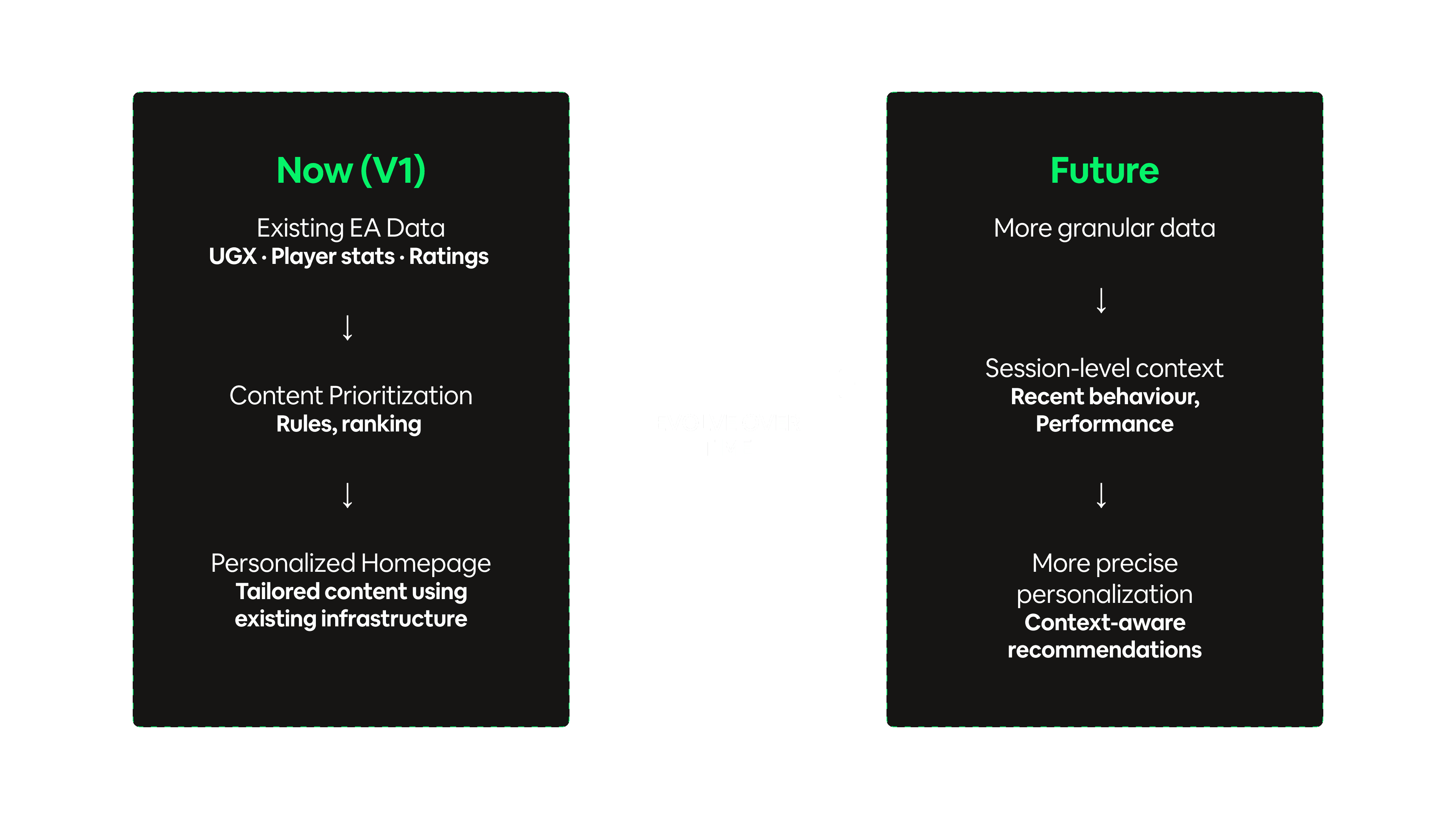
Starting With What We Already Had
We didn’t need to build a complex personalization system from scratch. EA already had player data we could use to start prioritizing more relevant content, with the ability to make recommendations more precise as richer behavioral data became available.

Measuring Success
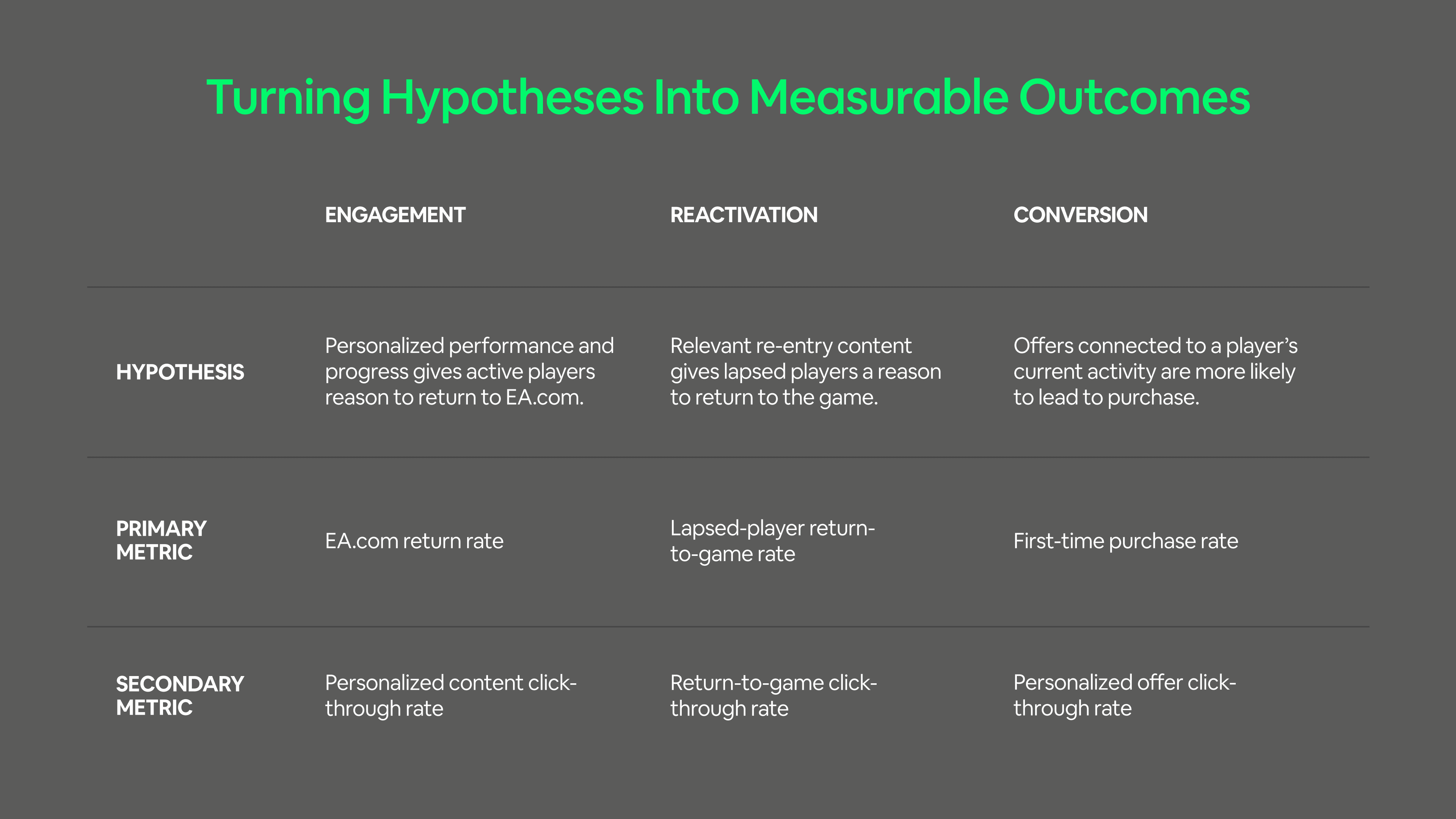
Did Personalization Change Player Behavior?
Before implementation, we defined how My Space could be tested against the existing experience to understand whether personalization changed player behavior.


Next steps
Start Focused, Learn, Then Scale
I left EA shortly after My Space was selected for the roadmap. If I were taking the concept forward, I’d focus first on validating the core personalization hypothesis before scaling the system.
Start focused
Launch with one franchise and a small set of high-confidence player signals.
Test and learn
Run controlled experiments to understand which personalized experiences actually change player behavior.
Scale what works
Expand successful patterns across more signals, player
segments and franchises.